Specific Diseases: When the pain comes from the spine
Content (Media + Text)
Wear-related or degenerative diseases of the spine primarily occur in the cervical and lumbar spine. Only a small percentage (<2%) is applicable to the thoracic spine. Usually, the segments of the spine that are subject to most of the strain are affected more often. Statistically, L5/S1 in the lumbar spine is affected more often than L4/5 etc. In the cervical spine, segments C6/7 are affected more often than C5/6 and C4/5. In general, it can thus be said that the likelihood of a degenerative disease increases from the bottom to the top (caudal to cranial).
Infobereich (Media + Text (Inhalte))
Clinical stages of disc degeneration: from hypermobility to spinal stenosis
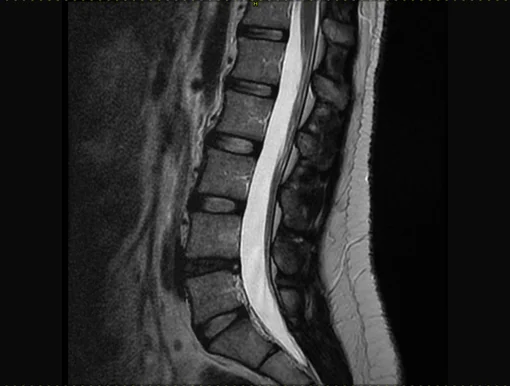
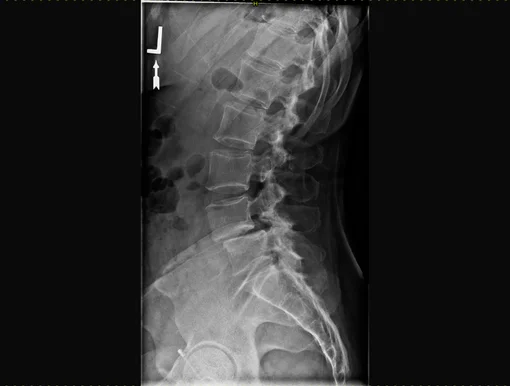
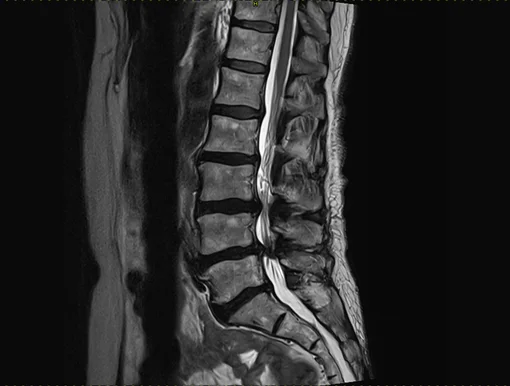
According to biological aging, degeneration runs in different phases. Initially, the water retention capacity decreases, resulting in a possible painful segmental hypermobility. During this phase, diagnostic imaging is often inconclusive. X-rays can show retrolisthesis, a reverse sliding of the upper vertebra over the lower vertebra. In the MRI, the affected intervertebral disc appears plain black (black disc), sometimes a small collection of fluid is seen in the rear fiber ring (annular tear), which is accepted as apparent pain symptom.
During the further course of the process, substance of the intervertebral disc is decreasing, disc height is diminished, leading, regardless of protrusions and/or herniations, to narrowing of the nerve exits, a lateral narrowing of the spinal canal called lateral stenosis. Advanced stages of degeneration lead to a complete loss of disc height causing complete narrowing of the spinal canal (central stenosis). X-rays and MRI show typical signs as well. Although increased stiffening can be assumed in the advanced stages, segmental instabilities can regularly be found, causing pain.
Classification and pathogenesis of spondylolisthesis
Sliding of the vertebral body (spondylolisthesis) can be divided into different groups. The most common causes are congenital or acquired conditions and generally occur in younger patients. However, with increasing age, the degenerative form of spondylolisthesis also plays a role. The main result is always instability with relating symptoms and the development of spinal stenosis. Decisive for this type of instability is that it is always characterized by a forward sliding of the upper vertebra against the lower vertebra.
How scoliosis changes the spine and causes narrowing
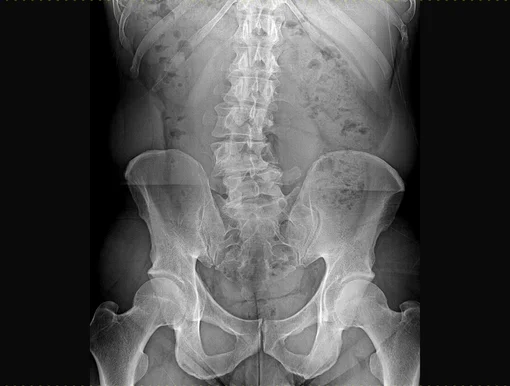
Development of a complex deformity of the spine in the form of scoliosis is subject to various causes. Scoliosis is characterized by a complicated incorrect rotation of individual vertebrae in the longitudinal axis, with subsequent lateral curvature of the affected spinal region. Significant deformities of the lumbar spine occur, which again result in lateral and/ or central narrowing of the spinal canal (lateral or central stenosis).
The mechanics of spinal canal narrowing
The spinal canal can be narrowed both laterally and centrally, resulting in spinal stenosis, which can lead to corresponding symptoms and must be treated according to its original cause.
Zitat
To anyone who might be dealing with chronic back pain, herniated, or degenerate spinal discs, I would highly recommend ENANDE. It is because of them that I am once again able to go about my work and live normally without back pain.
(Daniel Weaver, 27y. , 2 level disk replacement , April 2025)
More topics (Card-Links)
Explore more topics
Spine solutions
Learn more about it
Our services
Explore what we can do for you
Call-To-Action
Your personalized plan awaits
The first step toward a pain-free future is simple. Our expert team is ready to evaluate your needs and to design an individual treatment plan for you.
We use cookies on our website that are essential for the technical operation of the site. For more information, please see our Privacy Policy.
Protects against cross-site request forgery attacks.
Retention period: This cookie remains active only for the current browser session.
Saves the current PHP session.
Retention period: This cookie remains active only for the current browser session.
Der Dienst erfasst unter anderem die Herkunft der Website-Besucher, die Verweildauer auf einzelnen Seiten sowie deren Nutzung von Suchmaschinen und ermöglicht so eine effektivere Überwachung des Erfolgs von Werbekampagnen.
Provider: Google Ireland Ltd., Gordon House, Barrow Street, Dublin 4, Ireland
Retention period: Cookies verfallen nach 2 Jahren
Advertisers can use this to place ads that are primarily based on search results when users access the company's own services.
Provider: Google Ireland Ltd., Gordon House, Barrow Street, Dublin 4, Ireland
Retention period: Cookies verfallen nach 2 Jahren
Externe Videoplayer, Karten etc.
Provider: Vimeo.com, Inc., 330 West 34th Street, 10th Floor, New York, New York 10001, USA
Retention period: Session duration (e.g., 1 min) to 24 months (depending on the cookie)