Generally, damage in the area of the so-called motion segments of the spine can lead to back pain. Damages of the disc can lead to disc bulging, herniated discs and disc related instabilities. The wear of the disc can also cause pain by releasing tissue-damaging factors. Osteoarthritis of the facet joints can also provoke pain. As well as dysfunction, spinal stenosis can also cause chronic pain.
Additionally, instabilities of the spine such as sliding or rotational instability (spondylolisthesis and scoliosis) play a leading role in the cause of diseases. These degenerative causes have to be differentiated from changes in the spine due to inflammation (spondylitis/ spondylodiscitis), vertebral fractures (traumatic or osteoporotic) and tumors (primary tumors or metastases).
The psychological cofactors
In the context of back pain, the influence of psychological factors is considerable. It is known that depressive disorders exceedingly occur in connection with back pain. It is irrelevant whether the depressive component has existed prior to the onset of pain or has been caused by the persistent pain. Similarly, anxiety disorders play an important role; these disorders often result in so-called avoidance strategies in those affected, causing extensive changes in movement and stress in everyday life. Conflict situations in the social environment, especially negative stress, can lead to increased pain perception.
The functional causes
The complexity of movements in the human body requires stable muscular function. The back, abdominal and pelvic floor muscles are of particular importance when it comes to back pain disorders. If conditional loss of power of individual muscle parts happens due to adverse circumstances (restricted mobility, excess weight), imbalances could occur in the interaction of separate muscle groups, causing pain when moving or bearing weight.
Especially in the developed industrial countries, this aspect is of particular importance - decrease of physical exercise and less strenuous living and working conditions, often in combination with excess weight, gradually and unnoticed leads to a deconditioning of the muscles in the torso, rendering the muscles unable to provide necessary basic functions associated with maintaining an upright posture once a certain threshold has been crossed.
As a result, metabolic changes happen in the muscles, leading to a release of certain factors that cause tension and pain. This may not only be local pain. Depending on muscle distribution, complaints of radiating nature can also occur. These complaints are often linked with other physical symptoms.
The mechanisms of chronification
So far, modern science cannot explain why some people develop an independent pain disease which cannot be explained by physical or organic causes, while others don‘t. It is generally assumed that, regardless of the underlying cause, certain regulatory mechanisms in the nervous system of chronic pain patients, fail. In this, possible weaknesses are pain transmitting nerve tracts as well as the pain center itself.
In general, if pain persists for over 6 weeks it can be called chronic pain which may lead to chronic pain disease. It is recognized that a reduction in the so-called threshold of the pain center may result in an increased signal flooding with increased pain perception. Similar to phantom pain after a leg amputation, back or radicular pain may also become permanently imprinted in the so-called pain memory. Thus, irrespective of the underlying cause, pain can continue to exist or even re-occur.
Specific diseases: When the pain comes from the spine
Wear-related or degenerative diseases of the spine primarily occur in the cervical and lumbar spine. Only a small percentage (<2%) is applicable to the thoracic spine. Usually, the segments of the spine that are subject to most of the strain are affected more often.
Statistically, L5/S1 in the lumbar spine is affected more often than L4/5 etc. In the cervical spine, segments C6/7 are affected more often than C5/6 and C4/5. In general, it can thus be said that the likelihood of a degenerative disease increases from the bottom to the top (caudal to cranial).
The ENANDE team set everything up from start to finish [...] After surgery I immediately felt relieve from my current pain. There is no more pain in my left leg and foot, I stand straighter and can walk with no pain. Thanks to the team and Dr. Spiller for making this a success [...]
(Daryl Borkholder, 44 y. , 1 level disc replacement, August 2025)
Prozess
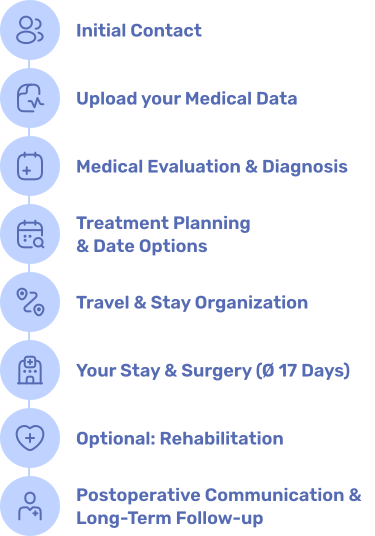
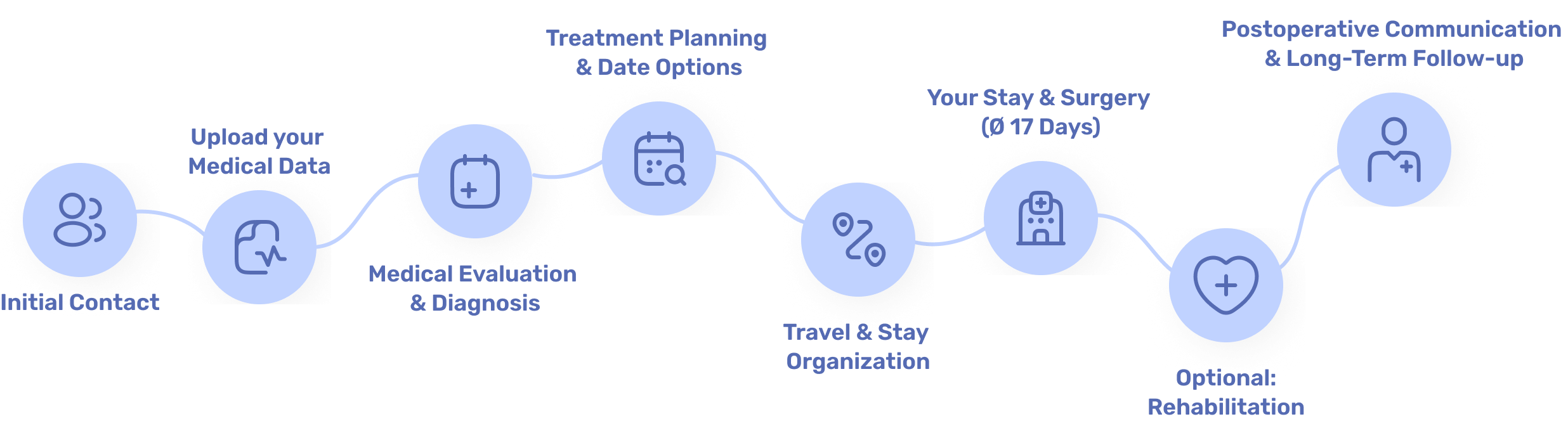
Your journey to recovery
From your first contact to long-term follow-up, ENANDE guides you through every stage of your journey. We personalize your treatment and manage all logistics – from evaluation and travel to recovery – ensuring your focus remains on healing.
Medical solutions for shoulder, spine, hip, and knee
Learn more
Our medical specialists
Meet them
Our outstanding specialist clinics
Discover them
Call-To-Action
Your Personalized Plan Awaits
The first step toward a pain-free future is simple. Our expert team is ready to evaluate your needs and to design an individual treatment plan for you.